Concrete testing checks the quality and strength of concrete in homes. It makes sure the material can withstand weather, weight, and time. For homeowners, knowing how to test concrete helps avoid problems like cracks and water damage.
It ensures driveways, basements, and foundations last for decades. Whether you’re building new or fixing old, testing concrete is key. It spots issues early, saving you from expensive fixes later.
This guide covers the basics of testing. You’ll learn about checking mixes during pouring and evaluating existing concrete. Understanding these steps is crucial for safe and lasting home projects.
Understanding Concrete Testing and Its Importance for Homeowners
Concrete is key in modern homes, from the foundation to the driveway. But, without checking, small problems can become big and expensive. Concrete testing types and procedure help make sure materials are safe, protecting homes and money.
Why Concrete Quality Matters in Residential Construction
Bad concrete can weaken a home’s structure. Cracks, water damage, and shifting ground can get worse over time. Testing catches problems early, saving a lot of money later on.
A 2023 study by the American Concrete Institute found 30% of foundation failures come from mix mistakes. Early checks can spot risks before they harm a home’s life span.
The Role of Testing in Preventing Structural Failures
Testing is like a safety net. Engineers use what are the tests to be done in concrete like checking strength or air content. These tests find weak mixes or bad curing.
Regular tests during building make sure materials meet codes, avoiding problems like cracks or uneven floors.
Common Concrete Issues That Testing Can Identify
- Low compressive strength: Tests measure how much weight walls and slabs can hold.
- Improper water-cement ratios: Too much water makes concrete weak, causing flaking or erosion.
- Honeycombing and voids: Tests find gaps in concrete, which make it weaker.
- Cracking from curing neglect
- – Tests check if concrete dried properly, stopping cracks and water damage.
Testing can turn big problems into small fixes. By fixing issues early, homeowners save money and keep their homes safe for years.
The Science Behind Concrete Strength and Durability
Concrete’s strength and durability come from its chemical and physical makeup. It’s made of cement, sand or gravel, water, and additives. When mixed, cement reacts with water, forming a bond that hardens over time.
This process takes weeks, not just minutes or hours. So, concrete doesn’t just dry—it matures.
The water-cement ratio is crucial. Too much water makes the bond weak, reducing strength. The right ratio creates a strong foundation. Keeping the mix moist during this process is key.
Without proper curing, the bond doesn’t form fully. This leaves concrete open to cracks and erosion.
Environmental conditions also affect concrete. Extreme temperatures during pouring can harm the hydration process. Freeze-thaw cycles in cold climates stress it, and chemicals like de-icing salts speed up decay.
Proper concrete testing can spot these risks early.
| Factor |
Impact on Durability |
| Water-Cement Ratio |
Low ratios increase compressive strength |
| Curing Process |
Ensures full hydration for long-term integrity |
| Temperature |
Optimal pouring temps prevent weak spots |
| Freeze-Thaw Exposure |
Leads to cracking without proper air entrainment |
| Chemical Exposure |
Additives in concrete testing help resist corrosion |
Knowing these basics helps homeowners understand why what are the five tests of concrete are important. These tests check if the mix is good and can handle environmental stress. By matching the mix to local conditions, testing keeps homes safe and stable for years.
Fresh Concrete Tests: What Happens Before Placement
Before concrete hardens, important tests check if it meets standards. These how do we test concrete steps help avoid mistakes and ensure it lasts long. Three main tests—slump, air content, and temperature—are crucial for homeowners to know.
Slump Test: Measuring Workability
The slump test checks how well the concrete flows. Here’s how it works:
- Concrete is poured into a special mold.
- The mold is lifted, and how much it drops is measured.
- This shows if the mix needs changes for easy placement.
For home foundations, a slump of 3-5 inches is typical. Driveways or flat areas might need 4-7 inches. The wrong slump can lead to cracks or unevenness.
Air Content Test: Ensuring Freeze-Thaw Resistance
In cold areas, the air content test is key to prevent damage. Air bubbles (4-8%) help by making space for expansion. There are a few ways to test this:
- Cold zones (e.g., Midwest): 5-7% air content
- Mild climates (e.g., Southwest): 3-5%
Contractors must keep records of these tests to meet ASTM standards.
Temperature Testing: Why It Matters
Concrete’s temperature when placed is very important. It should be between 50–70°F (10–21°C). Too hot or cold can weaken it. Workers use thermometers or sensors to check the temperature.
Pouring concrete in freezing weather can cause weak bonds. High temperatures make it set faster. Homeowners should make sure crews do these checks to prevent problems later.
Hardened Concrete Tests: Evaluating Your Foundation’s Strength
After concrete hardens, we use special tests to check its strength. The compression test and tensile test are key. They show if your home’s concrete can handle weight, movement, and weather over time.
Compression Test: The Gold Standard for Strength Measurement
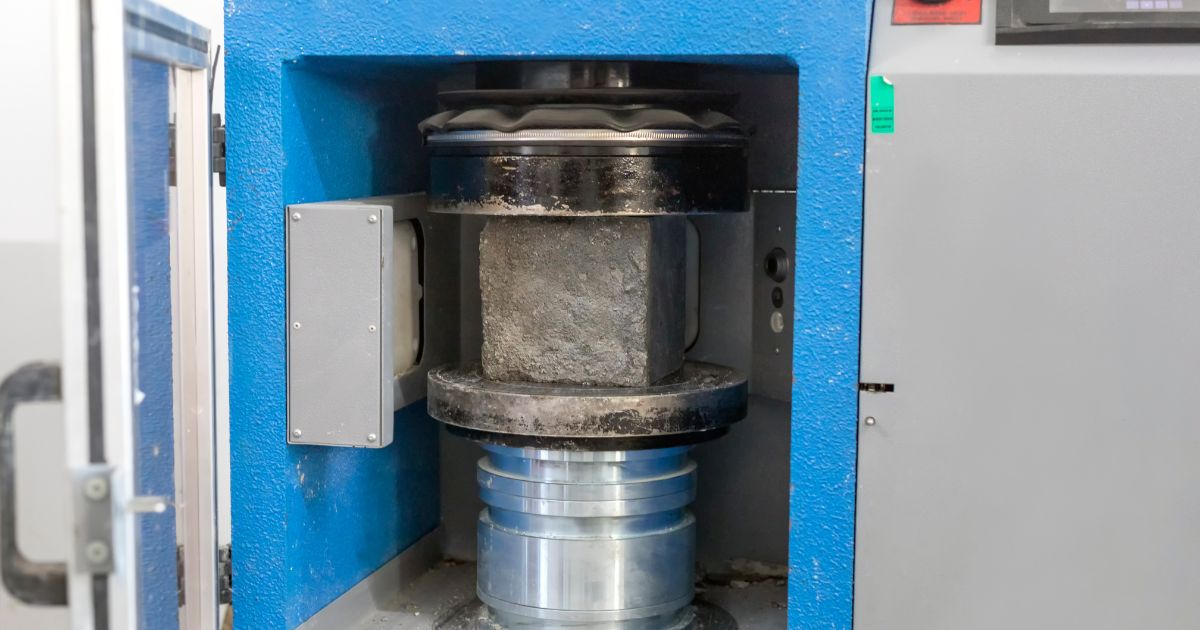
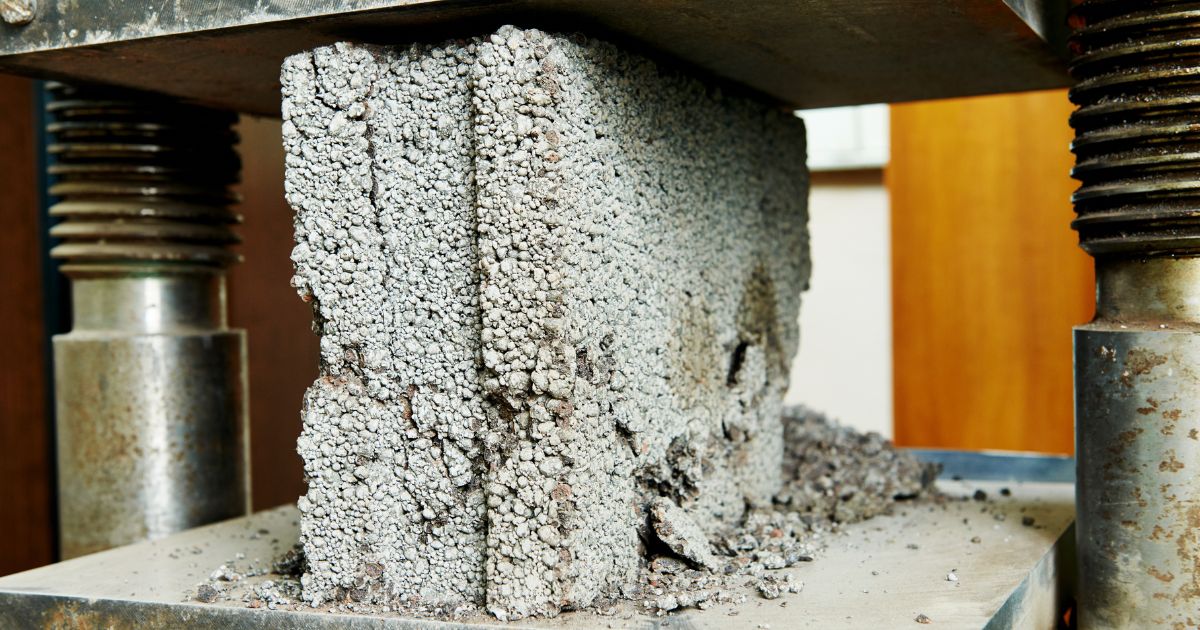
Concrete cylinders are made alongside your foundation and cured carefully. In a compression test, these are crushed until they break. Foundations need to be strong enough to hold heavy loads, like floors and roofs.
A high psi reading means the concrete is stronger than needed. This ensures your foundation can handle heavy loads well.
Tensile and Flexural Strength Tests
Tensile tests check how concrete resists stretching. They use a splitting tensile test or flexural tests to see how it bends. These tests are crucial for areas like driveways and pool decks.
They help us see how concrete holds up to uneven pressure from cars or water.
| Test Type |
Purpose |
Method |
Key Applications |
| Compression Test |
Measures compressive strength |
Cylinder samples crushed in hydraulic press |
Foundations, walls, columns |
| Tensile Test |
Assesses stretching and bending resistance |
Splitting cylinder or beam flexure |
Driveways, slabs, walkways |
Non-Destructive Testing Methods for Existing Structures
For older homes, we use non-destructive tests. These avoid damaging the structure. The rebound hammer checks surface hardness, and ultrasonic tests find internal flaws.
Ground-penetrating radar (GPR) finds bars or voids without drilling. These methods are great for checking aging foundations or patios without removing concrete.
Moisture and Permeability Tests: Protecting Your Home from Water Damage
Concrete’s ability to keep water out is key for your home’s strength. Moisture and permeability tests check if concrete can block water. This stops mold, rot, and damage to the structure. These tests are important before you put in flooring or finish your basement.
There are three main concrete testing types and procedure for checking moisture. The calcium chloride test looks at surface moisture, while relative humidity tests check inside the slab. Electrical impedance tests give quick surface readings. The rapid chloride permeability test (RCPT) tests how well concrete handles long-term salt and water exposure.
| Test Type |
Method |
Main Purpose |
| Calcium Chloride |
Covers slab with absorbent material |
Measures surface moisture over 60-72 hours |
| Relative Humidity |
Drills holes to place sensors inside slabs |
Assesses internal moisture levels |
| Rapid Chloride Permeability Test |
Applies electric current and salt solution |
Measures chloride ion movement through concrete |
How much moisture is okay depends on the flooring. For example, wood floors need moisture levels below 3 pounds per 1,000 square feet. If you ignore these tests, you risk damaged floors, mold, and corrosion in foundations. Waterproofing membranes and vapor barriers must match the test results to protect against groundwater.
Experts use these moisture and permeability tests to keep basements and foundations dry. This protects your health and keeps your home’s value up.
When Should You Request Concrete Testing for Your Home Project?
Knowing when to schedule concrete testing is crucial for your home’s safety and longevity. Here’s a simple guide for homeowners at every stage:
New Construction Testing Timeline
During new construction, tests are essential at key phases to ensure quality. Follow this timeline:
- Before pouring: Contractors perform slump tests and air content tests to check if the mix meets ASTM standards.
- During placement: Temperature checks and workability assessments confirm material consistency.
- At 7, 14, and 28 days: Core samples undergo compression tests to measure strength development. Structural engineers oversee these hardened concrete evaluations.
Homeowners should ask contractors for test results that meet local building codes.
Testing During Renovations or Additions
When adding a garage extension or patio, test existing concrete for compatibility. Key steps include:
- Core sampling to assess compressive strength before attaching new structures.
- Rebound hammer tests
- to check surface hardness and durability.
- Moisture content checks using calcium chloride tests for indoor projects.
Professional labs like CTLGroup or Holmes Lab provide these services to ensure new and old concrete work together safely.
Signs Existing Concrete Needs Testing
Look for these red flags requiring immediate action:
| Issue |
Recommended Tests |
Who to Contact |
| Cracks > 1/8” wide |
Core sampling, load testing |
Structural engineer |
| Uneven settling |
Rebound testing, ground penetration radar |
Geotechnical inspector |
| Spalling or flaking |
Carbonation tests, chloride analysis |
Material testing lab |
Act promptly if you notice these signs to prevent costly repairs.
DIY vs. Professional Concrete Testing: What Homeowners Can Do Themselves
Homeowners can do simple concrete testing types and procedure checks. But, they need experts for detailed structural tests. Basic checks like looking for cracks are easy, but pros handle tests like strength analysis.
- Visual inspection: Look for cracks wider than 1/8 inch, efflorescence, or uneven settling.
- Moisture test: Place a 12-inch plastic sheet on concrete for 16 hours; condensation indicates high moisture levels.
- Sound test: Tap surfaces with a hammer; hollow sounds signal delamination beneath.
Experts perform five main tests: compressive strength, tensile testing, air content, permeability, and imaging. These tests follow ASTM C31 and ACI 318 standards. For example, compression tests check psi ratings, and core sampling checks inside strength.
Professional services based on what’s needed. Make sure the lab is AASHTO or NATA accredited and the tech is ACI certified. Keep photos and measurements from your DIY checks to share with experts.
ASTM Standards in Construction & Concrete Testing
In the construction industry, ASTM standards help regulate materials, testing methods, and building practices to ensure durability and safety. Key Standards in the U.S. and Canada:
United States:
- ACI 318 – Defines minimum strength and placement practices for structural safety.
- ASTM C94 – Specifies quality criteria for ready-mixed concrete deliveries.
- ASTM C31 – Outlines procedures for testing concrete samples during construction.
- International Residential Code (IRC) – Integrates these standards into building permits and inspections.
Canada:
- CSA A23.1/A23.2 – Governs materials, mix design, and testing methods for concrete.
- NBC (National Building Code of Canada) – Sets performance-based requirements for residential construction.
- Provincial Codes – Adapt national standards to local conditions, such as freeze-thaw durability in colder provinces.
Regional Considerations:
State, provincial, and local codes adjust these standards based on climate and environmental risks:
- Canada’s colder regions (Ontario, Alberta, Quebec) require air-entrained concrete to withstand freeze-thaw cycles.
- Florida (U.S.) mandates higher-strength concrete for hurricane resistance.
- California (U.S.) and British Columbia (Canada) enforce stricter reinforcement rules in seismic zones.
Understanding Concrete Testing Reports and Results
Concrete testing reports are key to your home’s safety. They show results from tests like the compression test and two main tests: slump and air content. Let’s break down what they mean:
Key Metrics and What They Mean
Reports give you numbers like compressive strength, slump, and air content. For example, foundations need 3,000–5,000 psi. Driveways might need even more.
A slump test shows how easy the mix is to work with. It should be 3–5 inches. Air content should be 5–8% to stop cracks in cold weather.
- Compressive strength: Shows how much pressure concrete can take before breaking.
- Slump: Tells you how easy the mix is to work with.
- Air content: Helps prevent cracks in cold weather.
Red Flags in Testing Reports
Look out for these warning signs:
- Low compressive strength: If it’s too low, your foundation might need to be redone.
- Slump variations: Big differences in slump levels could mean mixing problems.
- High moisture levels: Too much moisture can cause floors to fail to stick together.
Questions to Ask Contractors
Ask contractors these questions:
“Did the compression test meet the project’s psi requirements?” or “Were all samples cured per ASTM C31 standards?”
Also, ask about the long-term effects: “How do these results affect my home’s durability in this climate?”
What Homeowners Should Verify:
✅ Contractor Compliance – Ensure contractors provide test results matching ACI, ASTM, or CSA benchmarks.
✅ Building Approvals – Confirm local building officials approve every phase of work.
✅ Material Certification – Request documentation proving materials meet required standards.
✅ Site Inspections – Verify compliance through moisture tests, air entrainment checks, and curing reports.
Both U.S. and Canadian authorities conduct inspections to confirm these standards are met, ensuring long-term safety, durability, and compliance in residential concrete construction.
Conclusion
Concrete testing is key to keeping your home safe. It’s important for both new and old homes. Knowing how to test concrete helps ensure it’s up to safety standards.
Tests like compression and moisture checks can save you money. They catch problems early. Homeowners should check their homes at every stage, from start to finish.
Getting certified reports and knowing about test results is crucial. New tools like sensors and apps help keep an eye on your home. They give you updates on humidity and cracks.
Being proactive is important. For new homes, make sure to test the concrete thoroughly. When renovating, check the foundation for weaknesses. Keep test records and talk to engineers if you find any issues.
Investing in quality now saves you money and stress later. It makes sure your home is safe for years to come.
FAQ
What are the tests to be done in concrete?
Concrete tests include the slump test, compression test, tensile test, air content test, and moisture tests. Each test checks different aspects of concrete, like quality, strength, and durability.
What is a slump test?
The slump test checks how well fresh concrete works. It fills a cone mold with concrete, then measures how much it settles. This shows if the concrete is ready to use.
How do we test concrete?
Testing concrete involves several steps. It includes fresh tests like slump and air content, and hardened tests like compression and tensile. These tests show the material’s strength and durability.
What are the five tests of concrete?
The five main tests for concrete are the slump, compression, tensile, air content, and moisture tests. Each test helps check the quality and performance of concrete in buildings.
What is a compression test?
The compression test checks the strength of hardened concrete. It applies a load until the concrete breaks. This test is key for ensuring buildings are strong.
What is a tensile test in concrete?
A tensile test checks how well concrete can handle pulling forces. It uses samples to measure strength, important for beams and slabs that bend.
What does an air content test indicate?
An air content test shows how much air is in concrete. It’s important for fighting freeze-thaw damage, especially in cold areas. Enough air helps prevent cracks and damage from moisture.
Why is moisture testing important for concrete?
Moisture testing finds moisture in concrete that can cause problems. It checks for mold, damage to finishes, and weakens structures. Tests like calcium chloride or relative humidity tests are used before flooring is installed.
When should concrete testing be conducted during construction?
Testing should happen at different times. Before placing concrete, during, and after it cures. This ensures the concrete meets quality and safety standards.
What are the risks of not conducting concrete tests?
Not testing concrete can cause serious problems like cracks and collapse. Bad concrete can lead to expensive fixes and harm the safety and life of a home.
What help can homeowners seek regarding concrete testing?
Homeowners should talk to structural engineers or concrete labs for testing advice. They can ask about testing, how to understand results, and what to do if problems come up.